01 — Enforcement
Single Decision Authority
Every agent action clears one gate. No parallel paths. No implicit permission by silence.
Governance for AI agents in the wild. Operational control with evidence you can defend.
EU AI Act transparency obligations take effect August 2, 2026. High-risk enforcement now follows in December 2027 — the Digital Omnibus moved the deadline, not the board question. When your board asks what your AI exposure is, “we’re looking into it” is not an answer. The Exposure Brief is.
If AI can access regulated data, call tools, trigger workflows, modify systems, or issue outputs teams treat as decisions — the problem is not model quality. It is governed execution.
If your AI can act, you need evidence — not reconstruction.
AI systems now read internal data, call tools, change system state, and emit outputs organizations treat as operational decisions. Evidence trails are often thin. Authority is often vague. When scrutiny arrives, everyone becomes a historian.
Your public footprint plus your top ten vendors: what your AI agents — and theirs — can reach, and what control evidence exists. Evidence-first, outside-in, no integration required. Every finding carries a source link and a confidence grade. Fixed fee from $1,500. Delivered in days, not quarters.
Control fails when it is written after the fact. Evidence has to be created at the moment action occurs.
Every agent action clears one gate. No parallel paths. No implicit permission by silence.
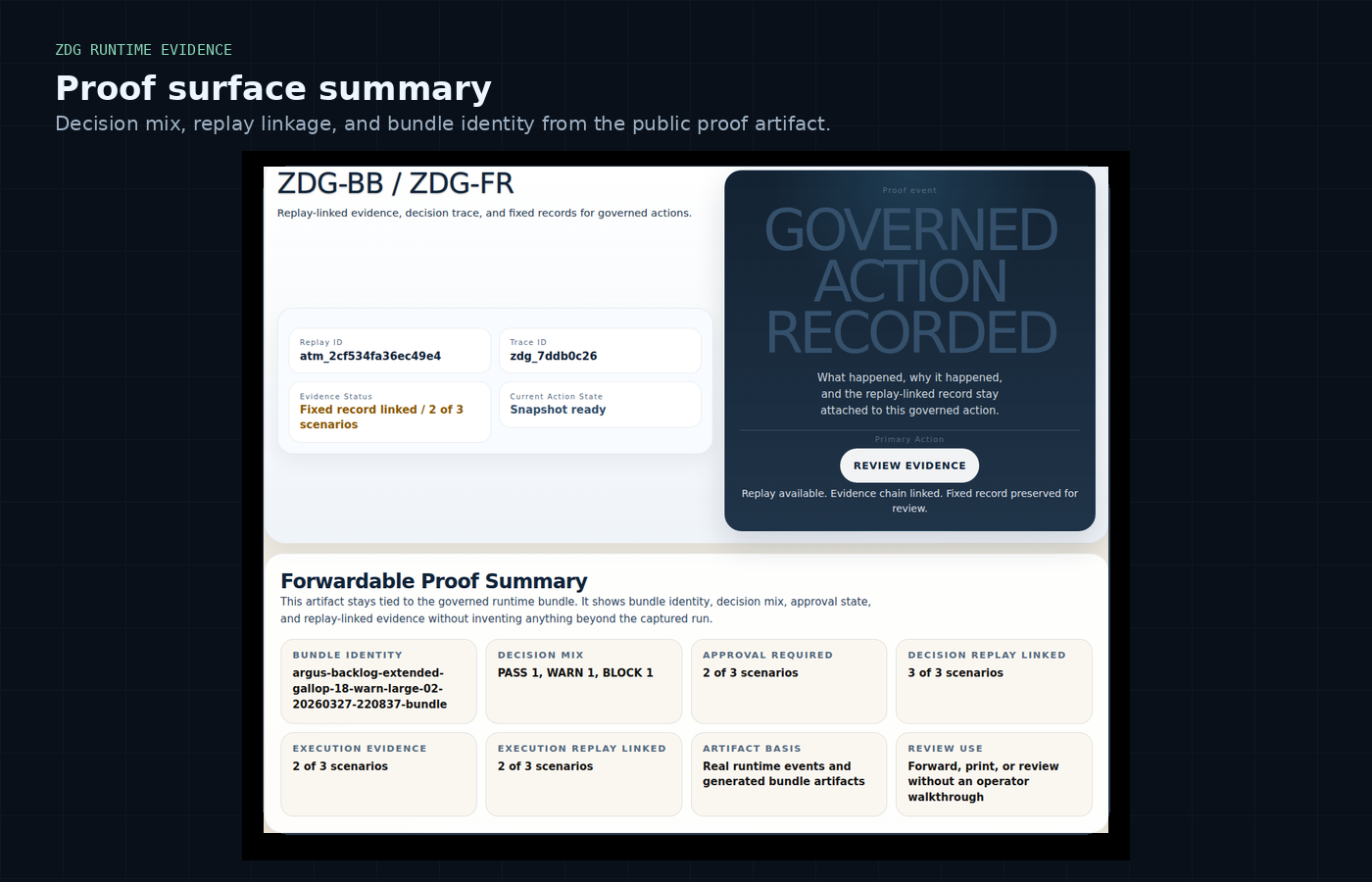
Every decision is recorded with the inputs, the policy version, and the outcome. Replay is possible. Reconstruction is not required.
What the system does reflects what the policy says — with the version active at decision time on the record.
Two commands. Verifiable output. No dashboard. No summary.
python -m core.zdg_control_center explain --task-id <id>Returns the decision record: inputs evaluated, policy version, outcome, approval status. One command, one auditable answer.
python -m core.zdg_control_center audit-integrityVerifies the evidence chain across all governed runs. No gap means no decision was made without a record.
Evaluates every agent action before it executes. Returns ALLOW, HOLD, or BLOCK. No action clears without it.
Records every governed event with replay fidelity. What happened, what was decided — all replayable, none reconstructed.
Designed to surface behavioral signals — reasoning drift, escalation, deception — during the run, not in the post-mortem.
Where human judgment is explicit and bound to execution. Approval is recorded, not implied by inaction.
Every action class an agent can perform has a tier, an evidence requirement, an approval boundary, a promotion rule, a demotion trigger — and for the consequential ones, a permanent human gate. The system may propose a promotion only when deterministic evidence supports it. A human applies it. Demotion is automatic on incident, intervention, rejection, or degradation.
No agent gets more autonomy because the code can do it. An agent gets more autonomy only because the ledger says the evidence supports it.
We run Zero Day Governance’s own operations under this system — hiring pipeline, publishing, and engineering agents’ commit rights included. In one supervised run this July, the system watched 48 companies, refused politely where robots.txt said no, recorded every one of 82 egress decisions in a verifiable chain, and halted for its human at every gate. That’s not a demo script. That’s Tuesday.
Some actions never earn autonomy, no matter the track record: publishing, outbound send, credential and profile truth claims, money movement, model-route changes. Gated by nature, permanently.
For organizations deploying AI in consequential workflows — where decisions must be defended, approvals recorded, and evidence must survive scrutiny.
The Flight Recorder in developer form. Instrument your agent, capture governed runs, and produce verifiable output from the first deployment.
Governance for AI that acts should look like operational control — not retrospective explanation.
The scan identifies where your governance posture is absent or undefendable. The platform gives you the infrastructure to close those gaps.